
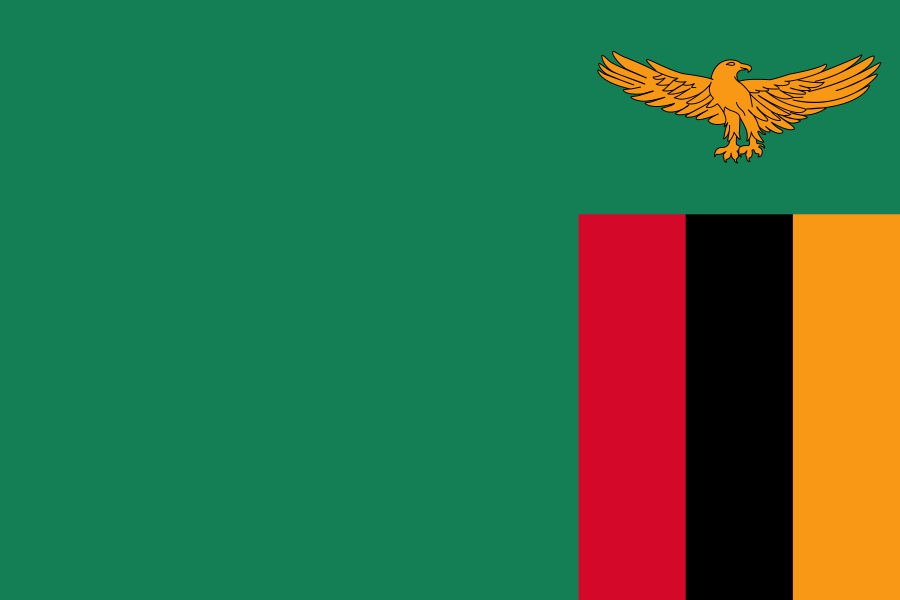
Zambia
About
Zambia is a landlocked country in Southern Africa, east of Angola and south of the Democratic Republic of the Congo. The capital, Lusaka, is named after a village located at Manda Hill, near where Zambia’s National Assembly building currently stands.
Zambia gained independence from the United Kingdom on 24 October 1964. The country’s poor, youthful population consists primarily of Bantu-speaking people representing nearly 70 different ethnicities, with a total population of over 20.7 million (2024 est.).
Zambia’s economy has historically been driven by copper mining, and the country has experienced periods of both economic growth and hardship tied to copper prices and drought. Today, Zambia maintains an active civil society and independent media, with elections regularly contested by a range of political parties.
Bantu-speaking groups mainly from the Luba and Lunda Kingdoms in the Congo River Basin and from the Great Lakes region in East Africa settled in what is now Zambia beginning around A.D. 300, displacing and mixing with previous population groups in the region. The Mutapa Empire developed after the fall of Great Zimbabwe to the south in the 14th century and ruled the region, including large parts of Zambia, from the 14th to 17th century. The empire collapsed as a result of the growing slave trade and Portuguese incursions in the 16th and 17th centuries. The region was further influenced by migrants from the Zulu Kingdom to the south and the Luba and Lunda Kingdoms to the north after invading colonial and African powers displaced local residents into the area around the Zambezi River, in what is now Zambia.
In the 1880s, British companies began securing mineral and other economic concessions from various local leaders. The companies eventually claimed control of the region and incorporated it as the protectorate of Northern Rhodesia in 1911. The UK Government took over administrative control from the British South Africa Company in 1924. During the 1920s and 1930s, advances in mining spurred British economic ventures and colonial settlement.
Northern Rhodesia’s name was changed to Zambia upon independence from the UK in 1964 under independence leader and first President Kenneth KAUNDA. In the 1980s and 1990s, declining copper prices, economic mismanagement, and a prolonged drought hurt the economy. Elections in 1991 brought an end to one-party rule and propelled the Movement for Multiparty Democracy (MMD) into power. The subsequent vote in 1996, however, saw increasing harassment of opposition parties and abuse of state media and other resources. The election in 2001 was marked by administrative problems, with three parties filing a legal petition challenging the election of ruling party candidate Levy MWANAWASA. MWANAWASA was re-elected in 2006 in an election that was deemed free and fair. Upon his death in August 2008, he was succeeded by his vice president, Rupiah BANDA, who won a special presidential byelection later that year.
The MMD and BANDA lost to the Patriotic Front (PF) and Michael SATA in the 2011 general elections. SATA, however, presided over a period of haphazard economic management and attempted to silence opposition to PF policies. SATA died in October 2014 and was succeeded by his vice president, Guy SCOTT, who served as interim president until January 2015, when Edgar LUNGU won the presidential byelection and completed SATA’s term. LUNGU then won a full term in August 2016 presidential elections. Hakainde HICHILEMA was elected president in August 2021.
Location
Southern Africa, east of Angola, south of the Democratic Republic of the Congo.
Area
Total: 752,618 sq km | land: 743,398 sq km | water: 9,220 sq km
Land boundaries
Total: 6,043.15 km
Border countries (8)
Angola 1,065 km; Botswana 0.15 km; Democratic Republic of the Congo 2,332 km; Malawi 847 km; Mozambique 439 km; Namibia 244 km; Tanzania 353 km; Zimbabwe 763 km
Climate
Tropical; modified by altitude; rainy season (October to April)
Zambia is landlocked.
Population: Approximately 22.7 million (2026 projection)
Capital: Lusaka
Official language: English
Major languages: Bemba, Nyanja (Chewa), Tonga, Lozi, Kaonde, Lunda, Luvale and more than 70 indigenous languages.
Administrative divisions: 10 provinces.
Source: Zambia Statistics Agency
2025
Transparency: 38
Public Participation: 19
Oversight: 50
Source: International Budget Partnership
Transparency International Corruption Perceptions Index (2025):
• Score: 37/100
• Global ranking: 99th of 182 countries
Zambia’s score declined from 39/100 (2024) to 37/100 (2025), marking its first decline in five years. Within Sub-Saharan Africa, Zambia performs slightly above the regional average but continues to face governance and corruption challenges ahead of the 2026 general elections.
Sources:
Ranked 4th in 2025.
Source: Africa Open Parliament Index
- Open Government Partnership member: Zambia became an OGP member in 2024 and is developing its first National Action Plan to strengthen transparency, accountability and citizen participation.
- Access to Information legislation: Zambia enacted the Access to Information Act, No. 24 of 2023, which gives members of the public the legal right to access information held by public institutions, subject to specified exemptions.
- Constitutional Right to Information: The Constitution of Zambia guarantees freedom of expression and democratic rights that underpin access to information, accountability and public participation.
- Public Sector Transparency: Public procurement is governed by the Public Procurement Act No. 8 of 2020, administered by the Zambia Public Procurement Authority (ZPPA).
- Public financing / political party financing: Political parties and elections are regulated under the Electoral Process Act No. 35 of 2016, administered by the Electoral Commission of Zambia. Zambia does not currently have a standalone Political Party Funding Act.
- Asset disclosure: The Parliamentary and Ministerial Code of Conduct Act requires Ministers and Members of Parliament to declare assets, liabilities and interests and establishes standards of ethical conduct for public office holders.
Capital
Lusaka (named after a village called Lusaka, located at Manda Hill, near where Zambia’s National Assembly building currently stands; the village was named after a headman (chief) LUSAKASA)
Independence
24 October 1964 (from the UK)
Constitution
History: several previous; latest adopted 24 August 1991, promulgated 30 August 1991.
Amendments: proposed by the National Assembly; passage requires two-thirds majority vote by the Assembly in two separate readings at least 30 days apart; passage of amendments affecting fundamental rights and freedoms requires approval by at least one half of votes cast in a referendum prior to consideration and voting by the Assembly; amended 1996, 2015, 2016; note – in late 2020, an amendment which would have altered the structure of the constitution was defeated in the National Assembly.
Legal system
Mixed legal system of English common law and customary law
Zambia has not submitted an ICJ jurisdiction declaration; accepts ICC jurisdiction.
Parliament
Unitary presidential constitutional republic: The President serves as both Head of State and Head of Government and exercises executive authority in accordance with the Constitution.
Sources: Constitution of Zambia (Official)
President: Hakainde Hichilema (since August 2021).
The President is directly elected for a five-year term and appoints the Vice-President, Cabinet Ministers and other senior public officials in accordance with the Constitution. Zambia’s next general election is scheduled for August 2026.
Current presidential term commenced: 24 August 2021
Sources: State House Zambia
Electoral Commission of Zambia
Constitution of Zambia
Parliament: National Assembly of Zambia
• Type: Unicameral.
• Term: Five years.
• Speaker: Nelly Butete Kashumba Mutti (since September 2021).
2026 Note: Zambia adopted the Constitution of Zambia (Amendment) Act, 2025, which substantially changed the composition of Parliament. Following the amendment, the National Assembly consists of 226 constituency Members, 40 proportional representation Members (20 women, 15 youth and 5 persons with disabilities), up to 11 nominated Members, the Vice-President, the Speaker, and two Deputy Speakers. As the 2026 general election will be the first conducted under these amendments, some international sources may still reflect the previous composition of 156 elected Members plus nominated Members. Users should therefore rely on the amended Constitution and official parliamentary sources for the most current composition.
Sources:
Zambia has an independent judiciary established under the Constitution.
Highest Court: Supreme Court of Zambia.
The judicial system also comprises the Constitutional Court, Court of Appeal, High Court, Industrial Relations Court, Subordinate Courts and Local Courts. Judicial authority is exercised independently in accordance with the Constitution and the Judiciary Administration Act.
National Assembly
Address: Parliament Road, P.O. Box 31299, Lusaka, Zambia. 10101
Telephone: +260 211 292425-36 | Fax: +260 211 292252
Email: info@parliament.gov.zm or webmaster@parliament.gov.zm
Website: https://www.parliament.gov.zm/
Monitoring

Zambia Council for Social Development (ZCSD) is an Umbrella of Civil Society Organisations whose main goal is promoting vibrant, independent and well-coordinated civil society organisation in Zambia.
Address
Plot 19057, Off Akashambatwa Road, Olympia Park Ext., Lusaka, P.O. Box 32997 Lusaka 10101, Lusaka, Democratic Republic of the Congo
+260 211 236 219 | +260978136521
Email: info@zcsdev.org.zm