
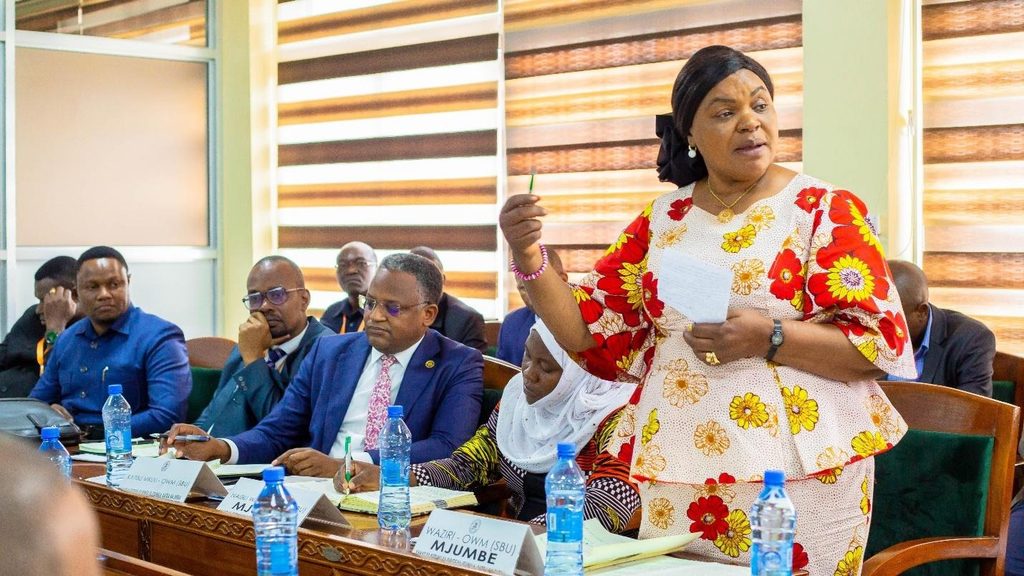
When access works, Parliament works better.
Since 2008, I have engaged with Tanzania’s Parliament in one form or another. Sometimes through parliamentary committees, sometimes through individual MPs, and at other times through the professional staff who keep the institution working beyond the life of any single Parliament.
That experience has taught me something simple: Parliament works better when good information, citizen experience and public evidence reach it at the right time, and when the people affected by decisions are able to speak for themselves.
During my years working in education, we regularly engaged MPs from different political parties who cared about education. We shared recent research and, importantly, what citizens themselves were saying. I saw MPs use that information to sharpen questions, build arguments and bring issues from communities into parliamentary debate.
Later, while working with Big Results Now, I engaged parliamentary committees looking at the implementation of national priority projects. At Twaweza, through Sauti za Wananchi and other research, we shared evidence about what Tanzanians were experiencing and thinking with MPs and committees. Sometimes it helped shape questions. Sometimes it informed debate around policy and legislation. We also worked with the parliamentary secretariat to strengthen the use of citizen evidence, institutional efficiency and digital transformation.
These experiences are why I resist a simple story about Parliament and public participation in Tanzania.
The channels exist. Parliament publishes Bills. Committees invite stakeholders to public hearings. Citizens and organisations can submit views. Tanzania also has the Access to Information Act.
I have seen engagement work.
But I have seen where the chain breaks.
The missing link is capability, timing and feedback
One part of Parliament that deserves more public attention is its professional secretariat. MPs are elected for a political term. Some return after an election; others do not. The parliamentary secretariat remains. Over time, I have come to think of these professionals as Parliament’s institutional memory.
Investing in their capacity to work with evidence, communicate with citizens and use new technologies strengthens Parliament beyond any single five-year term. The Constitution itself provides for the Secretariat of the National Assembly to support the effective discharge of Parliament’s functions.
But openness on the institutional side is only half of the story. Citizens and stakeholders also need the practical ability to engage.
I learnt this clearly during a legislative process affecting Tanzania’s creative sector. When I read the proposed Bill, I could see provisions that might significantly affect artists. I was not an artist, and I did not think an NGO should simply speak on behalf of people who could speak for themselves.
So, we brought lawyers and creative industry stakeholders together. The lawyers helped the artists understand what the Bill proposed and what particular provisions could mean for their work. The stakeholders then developed their own position and presented their views.
The most useful part was learning how to make a legislative submission Parliament could work with. It was not enough to say, “We do not like this Bill,” or demand that it be withdrawn. A stronger submission showed what the existing law said, what the Bill proposed to change, how that change might affect the sector and, crucially, how the provision could be written differently.
That experience stayed with me.
There is a difference between mobilising people to oppose something and enabling them to participate effectively in law making. Citizens must be free to reject a proposal they believe is fundamentally wrong, but where amendment can solve the problem, Parliament needs more than a grievance. It needs evidence, a clear understanding of the provision and a credible alternative.
This is where civil society has an important role. Our job should not always be to speak for citizens. Sometimes our most valuable contribution is to help citizens, communities and affected sectors understand the process, organise their evidence and speak for themselves.
Tanganyika Law Society (TLS) uses a similar approach when it circulates Bills to members through amendment schedules. UNDP’s current Legislative Support Project also recognises both sides of the equation: stronger parliamentary committees and secretariats, but also stronger citizen and civil society participation. It reports that 62 CSOs submitted evidence-based recommendations on Bills and aims to expand routine public consultations, including with marginalised groups.
Timing matters too. When a Bill is published early, stakeholders have time to understand it, consult those affected and prepare useful submissions.
A certificate of urgency can make this harder because the normal publication procedure may be compressed. There may be legitimate reasons for urgency, but less time means less opportunity for careful scrutiny. Parliament’s own guidance explains the special procedure for Government Bills, which are considered unusually urgent.
Even then, giving up is rarely the best civic strategy. Sometimes the window is narrow and imperfect, but there is still a window. Civil society needs the capacity to mobilise affected groups quickly and help them make the strongest possible contribution, while continuing to advocate for adequate consultation periods.
And even when consultation happens well, another problem remains.
We submit our views. Parliament considers the Bill. Eventually, legislation is passed. Then we wait for the final law to be gazetted. Only afterwards can we sit with the final text and ask: Which of our proposals were taken? Which were not? What changed? Why?
I have done that exercise myself.
It should not be an exercise in detective work.
From informing citizens to building a relationship with them
This is why I believe the most important next step is to close the distance between information, participation, influence and institutional response.
We can begin with comprehension. When an important Bill is published, the legal text could sit alongside a short Kiswahili explanation. What is changing? Why does it matter? Who could be affected? When are views due and how can they be submitted?
Understanding Parliament should not require a citizen to first become a lawyer.
Participation also must reach people where they are. Public hearings in Dodoma matter, but Tanzania is much larger than Dodoma. Mobile friendly submissions, radio, constituency channels, universities, professional bodies, civil society networks and digital platforms can help Parliament hear from people who may never enter a committee room.
This matters in a young country. Tanzania’s 2022 Population and Housing Census recorded 21.3 million people aged 15 to 35, representing 34.5 per cent of the population. Many younger Tanzanians experience public life through mobile phones and digital platforms. Putting a PDF online is not the same thing as digital participation.
UNDP has worked with the National Assembly and Zanzibar House of Representatives for years, and its current Legislative Support Project seeks to strengthen transparency, citizen participation, public consultation, evidence-based bill scrutiny and dialogue between Parliament and stakeholders.
But I would place one reform above all the others.
Close the feedback loop.
After a major consultation, Parliament should be able to tell citizens something very simple:
“You said. Parliament considered. This changed or did not change. Here is why.”
Those few words would change the experience of participation.
They do not mean Parliament must accept every recommendation. It should not. Parliament must weigh competing interests, evidence, constitutional responsibilities and political choices.
But there is a profound difference between knowing that your proposal was considered and rejected and never knowing whether anyone considered it at all.
That difference is where trust is built.
A practical pilot could begin with three major Bills in one parliamentary session. Each could have a short Kiswahili summary, a mobile friendly submission channel, outreach beyond Dodoma and a published feedback note afterwards. We could then ask harder questions. Who participated? From where? Whose voices were missing? What changed because of public input?
This is especially relevant as Tanzania implements Development Vision 2050. Dira 2050 seeks economic transformation, stronger human capability, technology and institutions capable of delivering long term prosperity. Its implementation framework also emphasises stronger accountability and evidence driven implementation.
Citizen engagement is part of that capacity.
Policies are stronger when institutions understand the experience of the people who will live with them. Implementation improves when citizens understand what public institutions are trying to achieve. Trust grows when people can see a connection between speaking and being heard, even when the final decision is not the one they preferred.
After nearly two decades of engaging Parliament, I remain convinced that Tanzania does not have to begin from zero.
I have seen research become a parliamentary question. I have seen citizens’ voices help legislators build arguments. I have seen committees go into communities and listen. I have seen stakeholders contribute to Bills and policies.
What we need now is to make those experiences less dependent on who knows whom, which organisation has access, or whether enough time happens to be available.
They need to become part of the normal architecture of Parliament.
So as Tanzania looks towards 2050, the measure of an open Parliament should no longer end with the question, “Did we publish?”
We should ask more.
Did people understand?
Could they participate?
Did we hear voices beyond the usual stakeholders?
Did we listen?
What changed?
And did we tell them?
When those questions become part of institutional practice, transparency stops being the end of the process.
It becomes the beginning of accountability.
Annastazia Rugaba is the Chairperson of the Tanzania Association of NGOs (TANGO).
Disclaimer: The views, opinions and statements expressed in this article are those of the Author and do not necessarily reflect the views or position of PMG. PMG does not endorse or necessarily agree with any of the opinions or conclusions expressed and has not independently verified all information contained herein. PMG accepts no responsibility or liability for the accuracy, completeness or content of the article, or for any reliance placed on the views or information expressed therein.